
Quick Takeaways: Do I Need a Party Wall Agreement? An Interactive Decision Guide
- Not every building project needs a Party Wall Agreement.
- Most projects fall under the Party Wall etc. Act 1996 if they involve work on a shared wall, building on the boundary, or excavating close to a neighbouring property.
- If your work is covered, you’ll normally need to serve the correct Party Wall Notice before construction begins.
- If your neighbour consents, the process is usually straightforward. If they dissent—or don’t respond within the statutory period—the dispute resolution process under the Act comes into play.
- The easiest way to avoid delays is to determine whether your project falls within the Act before builders arrive on site.
Building work often starts with excitement—a larger kitchen, a loft conversion or a long-awaited extension. Then someone mentions the words “Party Wall Agreement”, and suddenly everything feels more complicated.
The good news is that many homeowners worry unnecessarily. The Act doesn’t apply to every renovation, and it certainly isn’t designed to stop legitimate building work. Its purpose is much simpler: to provide a legal framework that helps neighbours avoid disputes when certain types of construction could affect adjoining property. Do You Need A Solicitor For Party Wall Act?
This guide helps you determine whether your project is likely to require the Party Wall process.
Quick Decision Guide: Does Your Project Need a Party Wall Agreement?
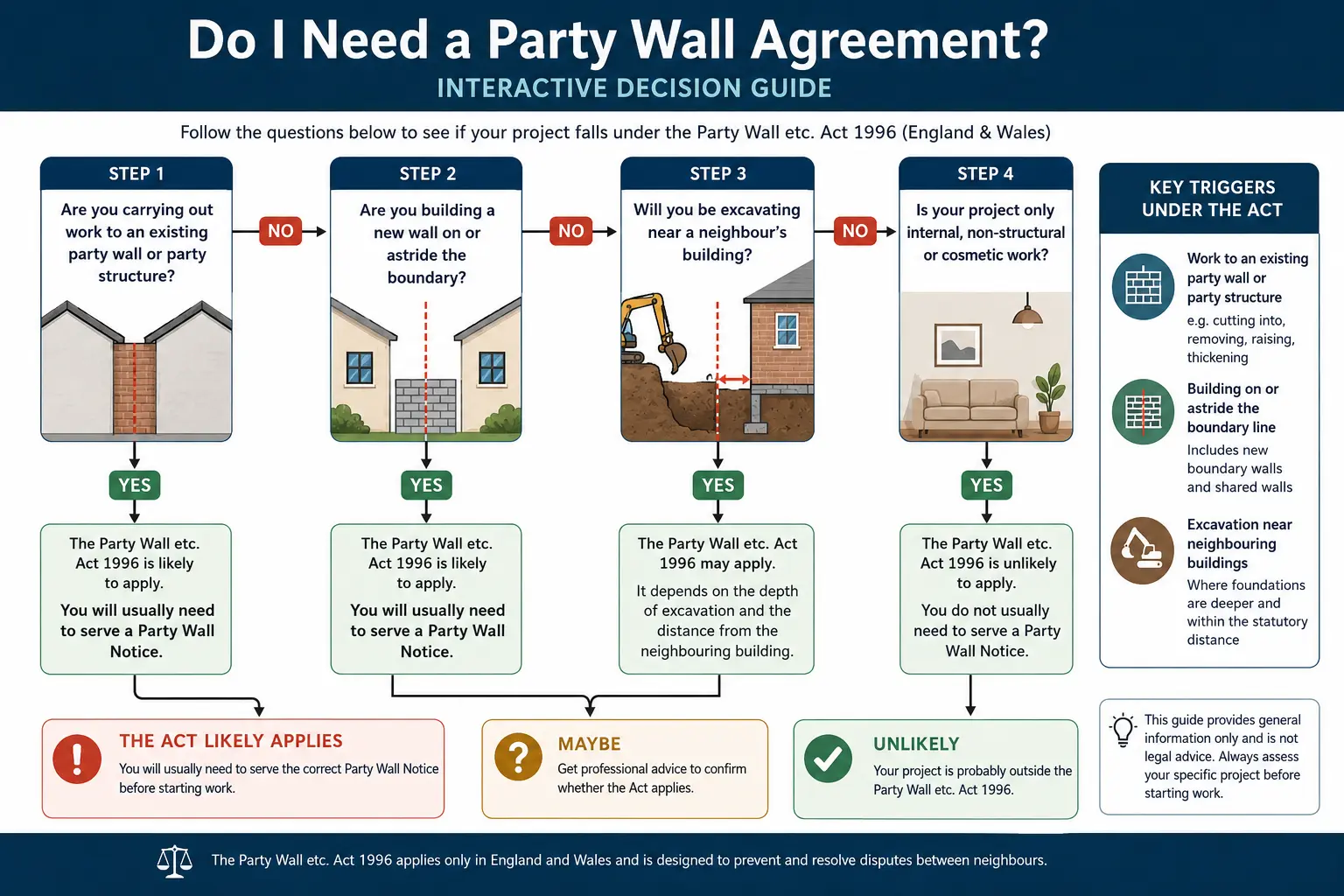
Start at Question 1 and follow the route that matches your project.
| Question | Yes | No |
|---|---|---|
| Are you carrying out work on an existing shared wall or party structure? | Continue to Question 2 | Go to Question 3 |
| Are you cutting into, raising, thickening or otherwise altering that wall? | The Party Wall Act is likely to apply. | Go to Question 3 |
| Are you building a new wall on or astride the boundary? | The Party Wall Act is likely to apply. | Go to Question 4 |
| Are you excavating for foundations close to a neighbouring building? | The Party Wall Act may apply depending on the location and depth of excavation. | Your project may not require Party Wall procedures. |
This decision guide is intended as an early assessment rather than legal advice. The exact application of the Act depends on the proposed works and the relationship between neighbouring properties.
What Types of Building Work Usually Require a Party Wall Agreement in Hitchin?

The simplest way to think about the legislation is this:
The Act isn’t triggered because you’re building an extension or converting your loft. It’s triggered because of how those works affect neighbouring land or shared structures. Damage Caused by Works Covered Under a Party Wall Award?
Broadly, projects usually fall into three legal categories.
1. Work to an Existing Party Wall or Party Structure
Examples include:
- Removing chimney breasts
- Inserting steel beams
- Cutting pockets into a shared wall
- Raising a party wall
- Thickening a party wall
- Underpinning a shared wall
These types of alterations directly affect a structure shared by adjoining owners, which is why the Act normally requires formal notification.
2. Building on the Line of Junction
This applies where a new wall is proposed, either:
- directly on the boundary, or
- astride the boundary where permitted by agreement.
Many homeowners assume this only affects terraced houses.
It doesn’t.
Boundary construction between detached properties can also trigger the Act, depending on exactly where the new wall will be built.
3. Excavation Close to a Neighbour’s Property
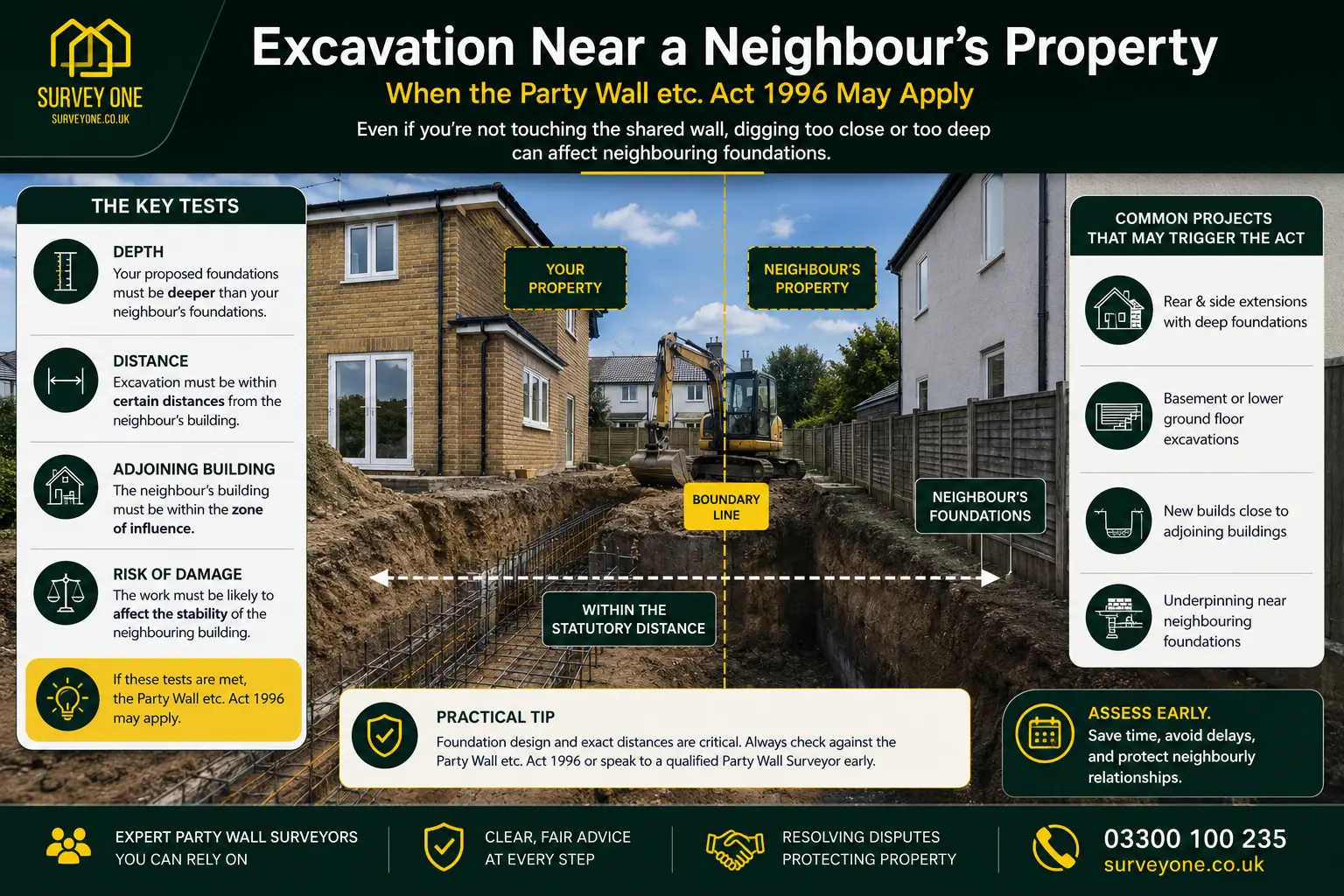
Foundation work catches many homeowners by surprise.
Even if you’re never touching the shared wall itself, excavation close to neighbouring foundations may still fall within the Act where the statutory distance and depth tests are met. These rules exist because excavation can influence the stability of adjacent structures, even when the work takes place entirely on your own land.
💡 What Most Articles Don’t Tell You
Many homeowners ask the wrong question.
Instead of asking:
“Do I need a Party Wall Agreement for an extension?”
The better question is:
“Will my extension involve work that activates one of the legal triggers in the Party Wall etc. Act 1996?”
Two identical rear extensions can have completely different legal requirements depending on where the foundations sit, whether steel beams are inserted into a shared wall, or how close excavation comes to neighbouring structures. That’s why project type alone never provides the full answer.
Does a Loft Conversion Need a Party Wall Agreement?
Sometimes yes.
Sometimes no.
A loft conversion in Hitchin, UK doesn’t automatically trigger the Act simply because you’re converting unused roof space.
The deciding factor is whether the work affects the existing party wall or party structure.
For example, many loft conversions require steel beams to be inserted into the party wall to support the new floor structure. Others involve cutting into the wall or raising it to accommodate roof alterations. Those activities commonly fall within the Act because they alter a shared structure.
By contrast, internal alterations that don’t affect the shared wall may not require Party Wall procedures.
Does a Rear Extension Need a Party Wall Agreement?
Sometimes it does, and sometimes it doesn’t. The deciding factor isn’t the extension itself—it’s whether the proposed work falls within one of the legal triggers set out in the Party Wall etc. Act 1996. Rear extensions commonly require Party Wall procedures where they involve excavation close to neighbouring foundations, construction on the boundary line, or alterations to an existing party wall.
This is one of the biggest misconceptions homeowners have. Two neighbouring houses can build almost identical extensions, yet only one project may require a Party Wall Notice because the foundations, boundary position, or structural design differ.
Before assuming you need an agreement—or that you don’t—consider these questions:
- Will the foundations be deeper than your neighbour’s foundations?
- Will excavation take place close to the adjoining property?
- Will steel beams bear into a party wall?
- Is any new wall being built directly on the boundary?
If the answer to any of these is “yes”, the Act is likely to become relevant and professional advice should be sought before work begins.
Does Removing a Chimney Breast Require a Party Wall Agreement?
In many cases, yes.
Removing a chimney breast attached to a party wall usually affects a shared structure in Hitchin. Even if the chimney breast is located entirely within your property, its removal may alter how the remaining masonry is supported. That is precisely why these works are commonly covered by the Party Wall etc. Act 1996.
Typical examples include:
- Removing a ground-floor chimney breast
- Removing chimney breasts on multiple floors
- Installing steel support beams
- Altering the shared chimney stack
Each project should be assessed individually because structural design varies considerably between older and newer properties.
What About Internal Renovations?
Many internal renovations don’t require Party Wall procedures in Hitchin, UK.
Decorating, replacing kitchens, rewiring, replastering or installing new flooring normally fall outside the Act because they don’t affect shared structures.
However, the internal work changes category once it involves the party wall itself.
Examples that may engage the Act include:
| Internal Project | Party Wall Act Likely to Apply? |
| Painting or decorating | No |
| Replacing kitchen units | No |
| Replacing flooring | No |
| Rewiring electrics | Usually No |
| Cutting into a party wall | Usually Yes |
| Installing steel beams into a party wall | Usually Yes |
| Underpinning a party wall | Yes |
The distinction isn’t whether the work happens indoors—it’s whether the structural work affects rights protected under the Act.
What Happens If Your Project Doesn’t Need a Party Wall Agreement in Hitchin, UK?
Not every project falls under the legislation, and that’s perfectly normal. There are some misconceptions around the party wall act, you can check those here.
If none of the statutory triggers applies, you generally won’t need to serve Party Wall Notices under the Act.
That doesn’t remove other legal responsibilities.
Planning permission, Building Regulations approval, restrictive covenants, access rights and neighbour relations may still be relevant depending on the project. The Party Wall Act addresses only a specific category of neighbour-related construction work—it doesn’t replace other legal requirements.
What Happens If Your Project Does Need One?
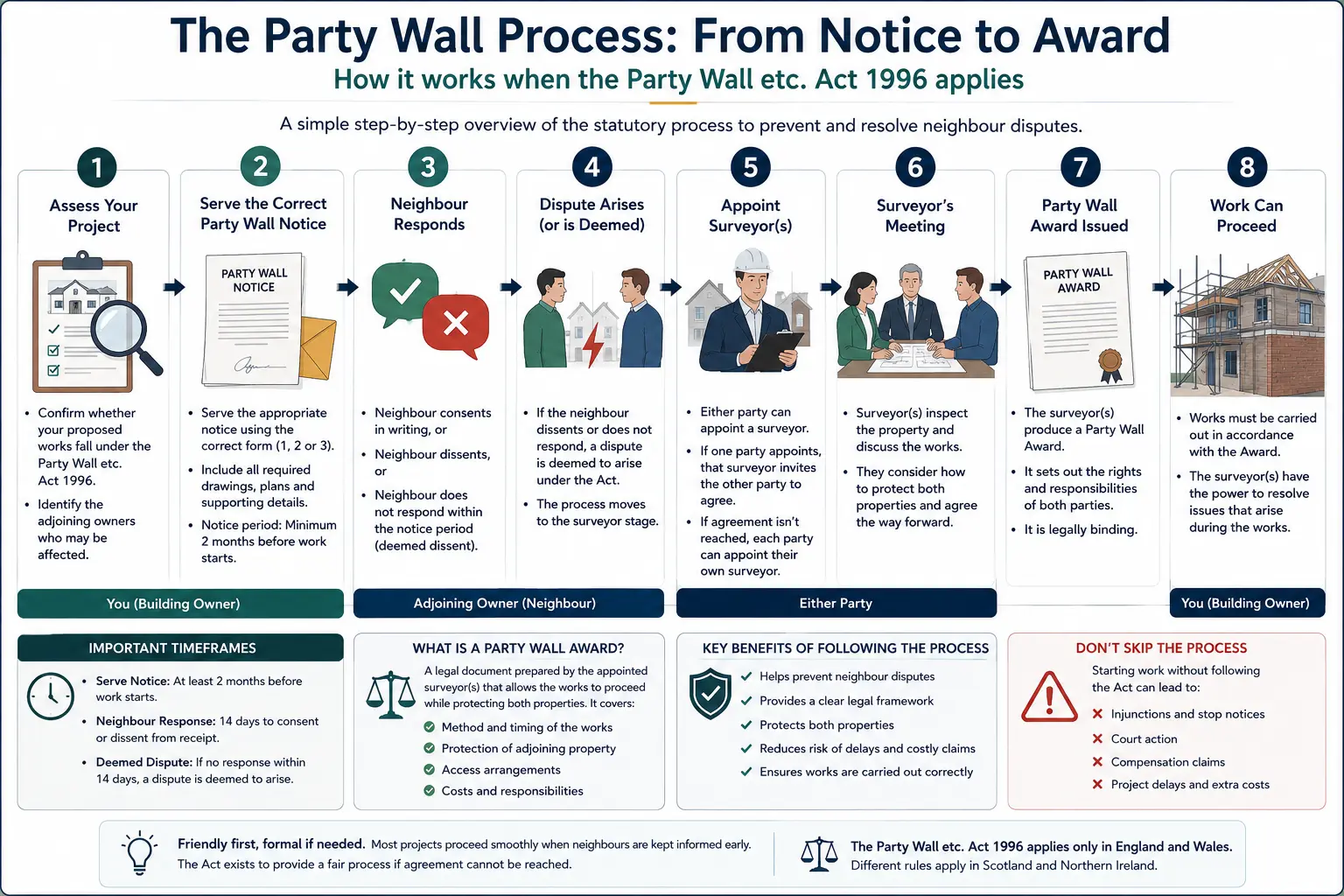
Where the Party Wall Act applies, there is a legally regulated procedure intended to eliminate disputes before any work commences.
The typical sequence is:
- Confirm whether the proposed works fall under the Act.
- Prepare and serve the appropriate Party Wall Notice.
- Allow the adjoining owner time to respond.
- If consent is given, the works can usually proceed in accordance with the Act.
- If consent is withheld—or no response is received within the statutory period—a dispute is deemed to arise, and the surveyor process begins.
Although many people refer to a “Party Wall Agreement”, the legal document produced after a dispute is formally known as a Party Wall Award. The Award records how and when the work may proceed while protecting the interests of both owners.
Common Misunderstandings About Party Wall Agreements in Hitchin, UK
Some of the most common myths include:
“Every extension needs one.”
No. Only projects that engage the statutory provisions of the Act require Party Wall procedures.
“My neighbour verbally agreed, so I’m covered.”
Friendly discussions are always helpful, but they don’t replace the legal process where the Act applies.
“Detached houses are exempt.”
Not necessarily. Excavations close to neighbouring buildings and boundary construction can still fall within the scope of the legislation.
“It’s only about shared walls.”
The Act also covers specific excavation work and new boundary walls—not just party walls themselves.
💡 What Most Homeowners Discover Too Late
Party Wall issues rarely cause problems because neighbours disagree.
They are more often than not responsible for delays because the need for Party Wall procedures is only recognised when builders are preparing to proceed. Once you reach that stage, statutory notice periods and the appointment of surveyors can influence project timelines. Determining whether the Act is applicable during the planning stage of a project is often far less difficult than resolving an issue with it once construction has been programmed.
The Calculated Steps and Decision-Making: Do You Need a Party Wall Agreement in Hitchin, UK?
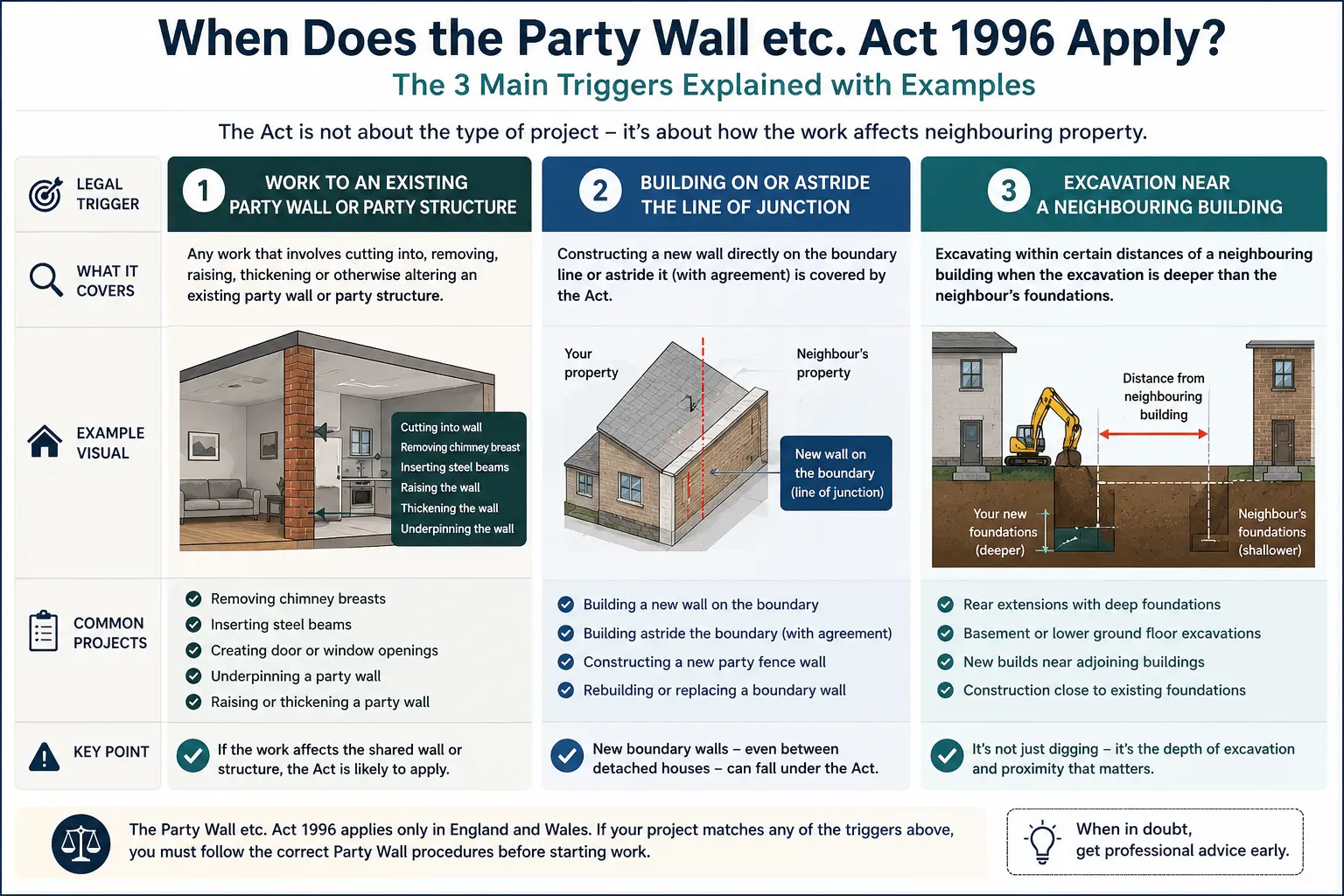
Answer each question in order. As soon as you reach a “Yes”, follow the guidance shown before moving to the next stage of your project.
Step 1 — Are You Working on a Shared Wall or Shared Structure?
Examples include:
- Cutting into a party wall
- Removing a chimney breast
- Inserting steel beams
- Raising the wall
- Thickening the wall
- Underpinning the wall
YES → The Party Wall etc. Act 1996 is likely to apply. A Party Wall Notice is usually required before work begins.
NO → Continue to Step 2.
Step 2 — Are You Building a New Wall on the Boundary?
This includes:
- Building directly on the line separating two properties.
- Building astride the boundary where agreement exists.
- Constructing a new party fence wall.
YES → The Act is likely to apply because new boundary walls fall within its scope.
NO → Continue to Step 3.
Step 3 — Will You Be Digging Foundations Near Your Neighbour’s Property?
Ask yourself:
- Are the new foundations deeper than your neighbour’s foundations?
- Is excavation taking place close to an adjoining building?
If both factors are present, the Act’s excavation provisions may apply. The legislation includes specific distance and depth tests, so these projects should always be assessed before work starts rather than after excavation begins.
YES → Party Wall procedures may be required.
NO → Continue to Step 4.
Step 4 — Are You Only Carrying Out Cosmetic or Non-Structural Work?
Projects such as these usually fall outside the legislation:
- Decorating
- Plaster repairs
- Installing a new kitchen
- Replacing flooring
- Electrical rewiring
- New bathrooms
- Internal joinery
Provided the work doesn’t alter a party wall, party structure or trigger excavation provisions, the Party Wall etc. Act 1996 is unlikely to apply. So for your question Do I need a Party Wall Agreement in Hitchin, is A No.
Decision Summary For Your Question: Do I Need A Party Wall Agreement in Hitchin, UK
| Your Project | Party Wall Process Likely? | Why |
|---|---|---|
| Decorating | No | No structural effect |
| Kitchen renovation | Usually No | Internal alteration only |
| Bathroom refurbishment | Usually No | Internal alteration only |
| Chimney breast removal | Usually Yes | Alters a shared structure |
| Loft conversion with steel beams | Usually Yes | Beams often bear into the party wall |
| Rear extension with deep foundations | Often Yes | Excavation provisions may apply |
| New wall on the boundary | Usually Yes | Covered by the Act |
| Garden shed away from boundaries | Usually No | Normally, outside the Act |
This table is intended as an initial screening tool rather than a substitute for assessing the specific details of a proposed project.
What If You’re Still Unsure?
Many projects sit in a grey area during the planning stage. You Still Might have the same thought, “Do I need a party wall agreement in Hitchin, UK”
Architectural drawings may still be evolving, foundation depths may not yet be finalised, or structural calculations may change as the design develops. In these situations, trying to answer the question yourself from online checklists can easily lead to the wrong conclusion.
A much better approach is to assess the proposed works against the three legal triggers under the Act:
- Work on an existing party wall or party structure.
- Construction on the line of junction.
- Excavation close to adjoining buildings.
If none of those circumstances applies, Party Wall procedures are less likely to be required. If one or more may apply, it’s sensible to establish the correct position before committing to a construction programme.
The Biggest Mistake Homeowners Make
Most people think the Party Wall process starts when a neighbour objects.
It actually starts much earlier.
The most common source of delay isn’t disagreement between neighbours—it’s discovering too late that statutory notices should have been served before work was scheduled. Contractors, scaffold bookings, and material deliveries can all be affected if the legal process isn’t considered early enough.
Key Takeaways
If you’re asking, “Do I need a Party Wall Agreement?”, focus on the proposed construction rather than the project title.
A loft conversion, extension or renovation doesn’t automatically fall under the Party Wall etc. Act 1996. What matters is whether the work affects a shared structure, involves building on the boundary, or includes qualifying excavation near neighbouring property.
Answering those questions early can make the planning process far smoother, reduce the risk of delays, and help ensure the correct statutory procedures are followed where required.
Frequently Asked Questions: Do I Need a Party Wall Agreement in Hitchin, UK?
Do I always need my neighbour’s permission before starting building work in Hitchin, UK?
No. Whether you need your neighbour’s formal involvement depends on whether your proposed works fall within the Party Wall etc. Act 1996. If the Act applies, you must follow its statutory procedures before starting work. That doesn’t necessarily mean your neighbour can prevent the project, but the legal process must be followed.
Are Party Wall Agreements and Party Wall Awards in Hitchin the same?
Not exactly.
Many homeowners use the term “Party Wall Agreement“ to describe the entire process. Legally, however, a Party Wall Award is the formal document prepared by the appointed surveyor or surveyors when a dispute arises, or is deemed to arise, under the Act.
Can my neighbour refuse to enter into a Party Wall Agreement?
An adjoining owner may dissent from the proposed works or withhold consent. That does not automatically stop the project. Instead, the Party Wall etc. Act 1996 provides a statutory dispute-resolution process through appointed surveyors, who determine how the work can proceed while protecting both properties.
What happens if my neighbour ignores the Party Wall Notice in Hitchin, UK?
If the adjoining owner or neighbour does not respond within the statutory response period, a dispute is deemed to have arisen under the Act. The next step is to appoint surveyor(s) to prepare a Party Wall Award before the relevant works begin. Read more on it here.
Can I serve a Party Wall Notice Even Myself?
Yes. The legislation does not mandate that the notice be served by a surveyor. But it should contain valid information which also adheres to the legal requirements of the Act. Mistakes can slow the process or spark needless arguments, and thus many homeowners turn to a professional for help.
Does the Party Wall Act apply to detached houses in Hitchin?
It can.
Although detached houses do not share a party wall with neighbouring properties, the Act may still apply if you’re constructing on the boundary or carrying out a qualifying excavation close to an adjoining owner’s building.
Does the Party Wall Act apply throughout the UK and in Hitchin?
No.
The Party Wall etc. The Act of 1996 applies only in England and Wales. Different legal systems apply in Scotland and Northern Ireland.